
cancer pain
INTRODUCTION
This brochure is intended for patients who have pain due to various types of cancer and contains information about the causes of cancer pain and its treatment. It may also be useful for family members and patients’ support systems to read this brochure as well.
PAIN TREATMENT FOR CANCER
Cancer pain is common. In the initial phase of the disease, about 30% of patients experience pain with 60–80% experiencing pain in the later stages. This pain, however, is often treatable. A correct diagnosis of the cause of the pain is very important for proper treatment: if we know what causes the pain, the pain can often be made bearable.
In the early stages of the disease, we focus mainly on the diagnosis and treatment of cancer itself as healing is the main goal but even in this phase, your specialist pays attention to the treatment of any pain that may be present. About half of the people with cancer eventually recover and the pain usually lessens or disappears. Pain may persist even when the disease is under control, however.
In a later stage of cancer, for example, extensive metastases or continued growth of the tumor, a cure is less likely. In this phase, treatments can be given to inhibit the growth of cancer. This can also reduce pain but symptomatic treatment with painkillers is often necessary.
CAUSES OF CANCER PAIN
Cancer pain can be caused by:
- Direct growth of a tumor in surrounding structures such as skin, nerve tissue, or organs;
- Indirect consequences of cancer such as fractures, ulcers, infections, blockage of hollow organs or blood vessels, or increased pressure in the brain;
- The treatment of cancer such as scar pain after surgery, phantom pain after amputation, tissue damage due to radiation, or nerve damage due to chemotherapy or surgery;
- Other conditions that are not related to the disease (e.g. a worn-out back) can also cause pain in patients with cancer.
PAIN MEDICATION
Most cancer pain can be treated with drugs. Several things are important here:
- Do not wait to take the prescribed painkillers until the pain is unbearable: by taking the medication at the agreed time, you can try to get ahead of the pain;
- Take the painkiller as regularly as possible to prevent the (severe) pain from returning;
- Do not be afraid of addiction or breathing problems when using strong painkillers such as morphine. If you use these agents by prescription and in consultation with your treating doctor, there is no reason to be afraid of these agents or side effects;
- The use of (high dose) painkillers in an early stage of the disease does not mean that these drugs are no longer effective at a later stage. A certain amount of resistance to the drugs can be expected, but in most cases, it is possible to increase the dose of the drugs without them becoming ineffective.
TREATMENT PLAN
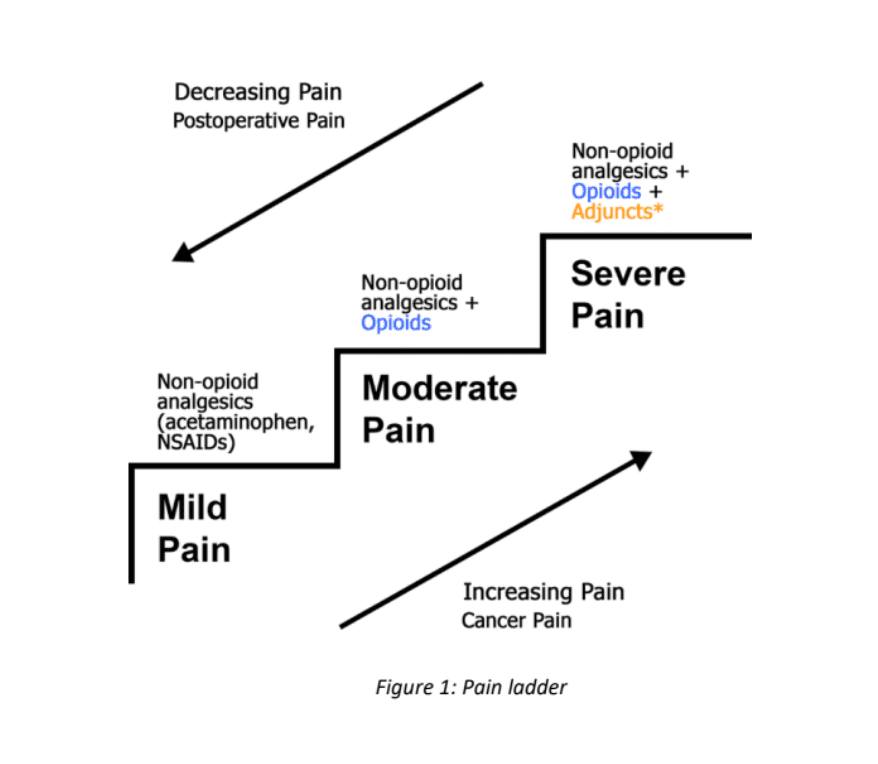
We prescribe painkillers according to the pain ladder. We give step-by-step remedies with an increasingly stronger pain-relieving effect, sometimes combining different methods of pain relief.
Below is an explanation of the different steps of the pain ladder.
Step 1— Mild pain
The first step of the pain ladder is treatment with paracetamol and/or anti-inflammatory painkillers (NSAIDs). The group of NSAIDs includes drugs such as Ibuprofen (Brufen®), Diclofenac (Voltaren®), Naproxen (Naprosyne®) and Indomethacin (Indocid®). Paracetamol and NSAIDs are also referred to as ‘minor’ painkillers. They are often available without a prescription at drug stores. These agents are particularly effective for mild to moderate pain, regardless of the cause of the pain. Both paracetamol and NSAIDs are not only pain-relieving but also antipyretic (used to prevent or reduce fever). NSAIDs also prevent inflammation.
Paracetamol has minimal side effects. The main side effects of NSAIDs are upset stomach, impaired kidney function, and blood clotting problems. Because of these side effects, you should only use NSAIDs in consultation with and on the prescription of your treating doctor.
Step 2
Step 2 is skipped in the treatment of cancer pain.
Step 3—Severe pain
In step 3 of the pain ladder, morphine-like agents (opioids) are added to an agent from step 1. Examples of opioids are Morphine, Oxycodone, Fentanyl, and Methadone. These agents are available in various forms such as tablets, capsules, drinking ampoules, patches, melting tablets under the tongue, nasal spray, and injections.
Your attending physician will discuss with you which drug and which form of administration is most appropriate for you in your situation.
There is a lot of (mis)information on how opioids work. These drugs are often thought to be very dangerous and addictive. Opioids can be used long-term and in high doses without any danger if you follow the instructions given to you by the specialists who prescribed them for your pain. The main side effects of opioids are constipation, nausea, and drowsiness.
- Constipation almost always occurs and is worsened with a higher dosage. As such, all patients receiving morphine or any other opioid are prescribed a laxative to help with bowel movements;
- Nausea occurs in 30-40% of patients, especially in the first weeks after starting an opioid. The risk of nausea decreases the longer you use opioids and nausea can often be treated with additional medications;
- The higher the prescribed dosage, the greater the risk of drowsiness (sleepiness). If necessary, drowsiness can also be treated with medication.
Step 4: Invasive Pain Treatment for severe pain
By invasive pain treatment, we refer to several techniques such as nerve blocks and the insertion of a catheter (tube) in the back. In the event of a nerve block, we interrupt the pain conduction in the nerve using an injection. As a result, the pain signal no longer reaches the brain and you feel less pain. The goal of invasive pain treatment is long-term pain relief. These treatments are only possible in specific cases and where treatment with other drugs does not work well or causes too many side effects. You can ask your doctor if this is an option for you. Separate brochures are available with information on these treatments.
BREAKTHROUGH PAIN
Cancer pain is typically not continuous. Sometimes there is additional pain during the care that is referred to as break-through pain. Because of this, your specialist often prescribes a combination of a long-acting and a fast-acting drug and you will always receive an explanation about the use of these different medicines.
ADDITIONAL MEDICATION
Sometimes additional drugs are needed for special types of pain. For example, with nerve pain, sometimes the painkillers from the pain ladder do not work well.
With this type of pain, specific medications for nerve pain are used. These are drugs that are not specifically created to be painkillers but can have a pain-relieving effect. For example, drugs used to treat depression or epilepsy can be used as pain relievers for nerve pain. If you happen to be prescribed these drugs, it is not because your specialist thinks you are depressed or have epilepsy, but because of their specific effect on nerve pain.
Examples of other additional agents are hormone replacement therapy (HRT) which can be used to reduce swelling around a tumor and anti-anxiety medication. Sleeping aids are also regularly prescribed because a good night's sleep contributes to pain reduction.