
spinal nerve root block
INTRODUCTION
After assessing your medical history, condition and treatment options, the anesthesiologist/pain specialist has consulted with you and concluded that a spinal nerve block is the most suitable treatment option for you. This brochure contains general information about spinal nerve blocks and what you can expect. General information about nerve blocks can be found in the brochure on nerve blocks.
WHAT IS A SPINAL NERVE BLOCK
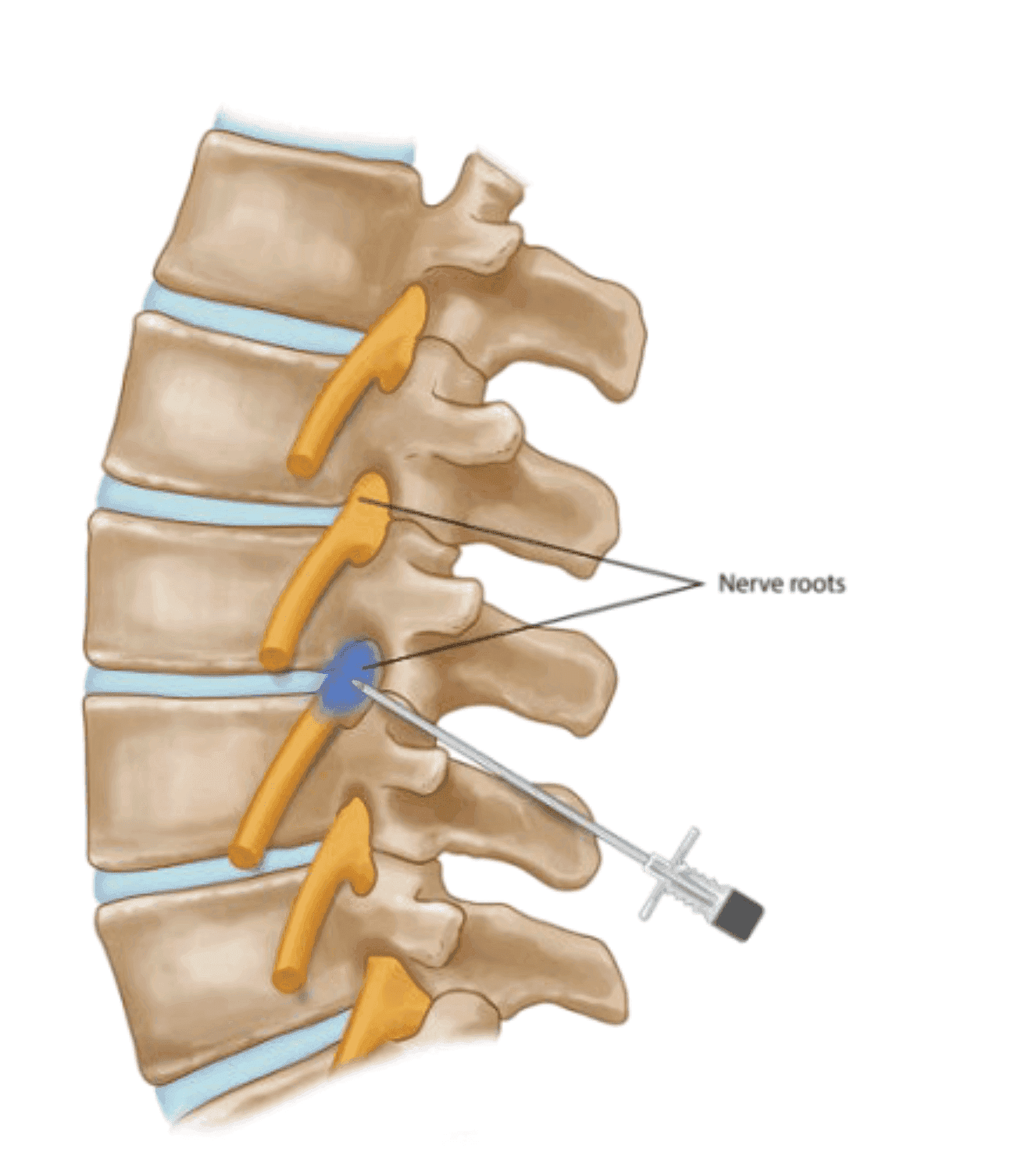
A spinal nerve block is an injection of a local anesthetic (numbing agent) and a steroid, administered under X-ray guidance in the area where the nerve leaves the spine. The treatment can be performed in the neck, chest or lower back. A spinal nerve block can be helpful for the following complaints:
- Neck pain radiating to the head, shoulder, arm, hand and/or fingers;
- Back pain radiating to the buttock(s), leg, foot and/or toes;
- Radiating pain in the arm or leg after a herniated disc operation.
WHAT IS THE DIFFERENCE BETWEEN A DIAGNOSTIC BLOCK AND A THERAPEUTIC BLOCK
For certain pain complaints, the anesthesiologist/pain specialist will first try to determine which nerve is conducting the pain by means of one or more diagnostic (test) blocks. A diagnostic block is the temporary numbing of the nerve. All medical treatments and procedures carry risks, but treatment with a spinal nerve block rarely leads to permanent damage. The anesthesiologist/pain specialist will also discuss your medical history with you to make sure there are no other factors that could lead to complications and, if there are, how the procedure can be performed most safely and with minimal risks.
Possible side effects are:
- Bruising or muscle pain at the injection site. If this occurs, it may last a few days, but can be treated with paracetamol if necessary.
- Sometimes there may be a temporary loss of strength or sensation in the leg. This is temporary and lasts a few hours. Therefore, it is important that you go to the hospital accompanied and do not drive home yourself.
- After treatment with high-frequency current, there may sometimes be a temporary reduction of sensation in the skin near the treated nerve block. After a few weeks, the sensation will slowly restore itself.
- After the treatment, hot flashes may occur and menstruation may be temporarily disrupted. In patients with diabetes, blood sugar levels may be higher than normal for a few days.
- Do you have questions or would you like more information? Then contact the outpatient clinic using the contact details at the back of this brochure.
- The outpatient clinic is open on Tuesdays and Wednesdays.
Brochure on spinal nerve root block
A definitive or therapeutic nerve block can only be performed after the nerve conducting the pain has been located. A diagnostic block is not always necessary for this. Your treating specialist will discuss in advance whether or not this is necessary.
A therapeutic nerve block can provide pain relief for a longer period of time. If the complaints return, the block can be repeated if necessary.
It is usually not possible to perform a diagnostic and a therapeutic block on the same day. However, your treating specialist aims to keep the time between the diagnostic and the definitive block as short as possible.
In some cases, the anesthesiologist/pain specialist may decide to perform a therapeutic block directly. This will always be discussed with you in advance.

HOW CAN I PREPARE
- If you use anticoagulants (also called blood thinners) (for example Sintrom®, Marcoumar® or Acenocoumarol, Rivaroxaban or Dabigatran), you must stop taking them before the treatment. Consult your anesthesiologist/pain specialist to find out how long in advance you should stop.
- Inform the anesthesiologist/pain specialist of any allergies or hypersensitivity to X-ray contrast fluid or if you are pregnant or may be pregnant;
- The treatment almost always takes place on an outpatient basis. Please note that after a spinal nerve block you may NOT drive home yourself, because after the block there may be temporarily less strength in the treated area. You may also feel tired and dizzy after the treatment.
- With a spinal nerve block you may usually eat and drink as normal. If you need to fast, the specialist will discuss this with you in advance.
- If you have a fever on the day of the treatment, the treatment unfortunately cannot proceed as planned. Contact the outpatient clinic as soon as possible using the contact details on the back of this brochure!
WHAT IS THE PROCEDURE
The treatment room of the pain clinic is located in the operating theatre. The anesthesiologist/pain specialist and an anesthesia nurse are present during the treatment.
For the treatment you lie on your stomach or back, depending on the location where the block is to be performed. During the treatment, X-rays are often taken; the device is placed next to the table on which you are lying.
The block is performed with special needles and the place where the needle is inserted depends on where you experience pain. This is determined very precisely in advance. Before the needle is inserted, the anesthesiologist/pain specialist disinfects the skin and the anesthesia nurse administers a local anesthetic at the spot where the block will be performed.
The anesthesiologist/pain specialist guides the treatment needle to the nerve to be treated using X-ray imaging. During the treatment, the anesthesiologist/pain specialist checks with the help of X-rays whether the needle is in the correct place. For a good X-ray image, it is sometimes necessary to inject contrast fluid. The anesthesiologist/pain specialist also sends small electrical pulses through the needle to check whether it is in the correct place.
After you have indicated when and where you feel the pulse, the medications are administered. In a diagnostic block, a short-acting anesthetic is injected. For a long-term treatment, a combination of an anesthetic and a corticosteroid (an anti-inflammatory agent) is usually injected. The corticosteroid reduces the irritation of the nerve and ensures that the pain relief lasts longer. It takes a few days or weeks before you notice the optimal effect of the corticosteroid.
In some cases, the nerve is treated with a special high-frequency current for a longer-lasting effect (therapeutic block). A nerve block with a longer-lasting effect (with medication and/or high-frequency current) cannot take place on the same day as the diagnostic block. You will receive a separate appointment for this.